
Vietnam Leads Asia's Eco-Tourism Boom

Across the Asia-Pacific region, a profound shift is permanently altering the DNA of holiday planning. Sustainability, once considered a premium niche or a marketing buzzword, has officially crystallized into the defining baseline standard for both domestic and international travelers. At the absolute forefront of this structural transformation is Vietnam.
Driven by aggressive green infrastructure policies, community-led conservation frameworks, and a surging consumer appetite for authentic, low-impact experiences, Vietnam's tourism sector is accelerating its transition toward a greener development model. From the jagged, mist-shrouded peaks of Ha Giang to the pristine marine environments of Phu Quoc, the country is rapidly rewriting the playbook for responsible travel in Southeast Asia.
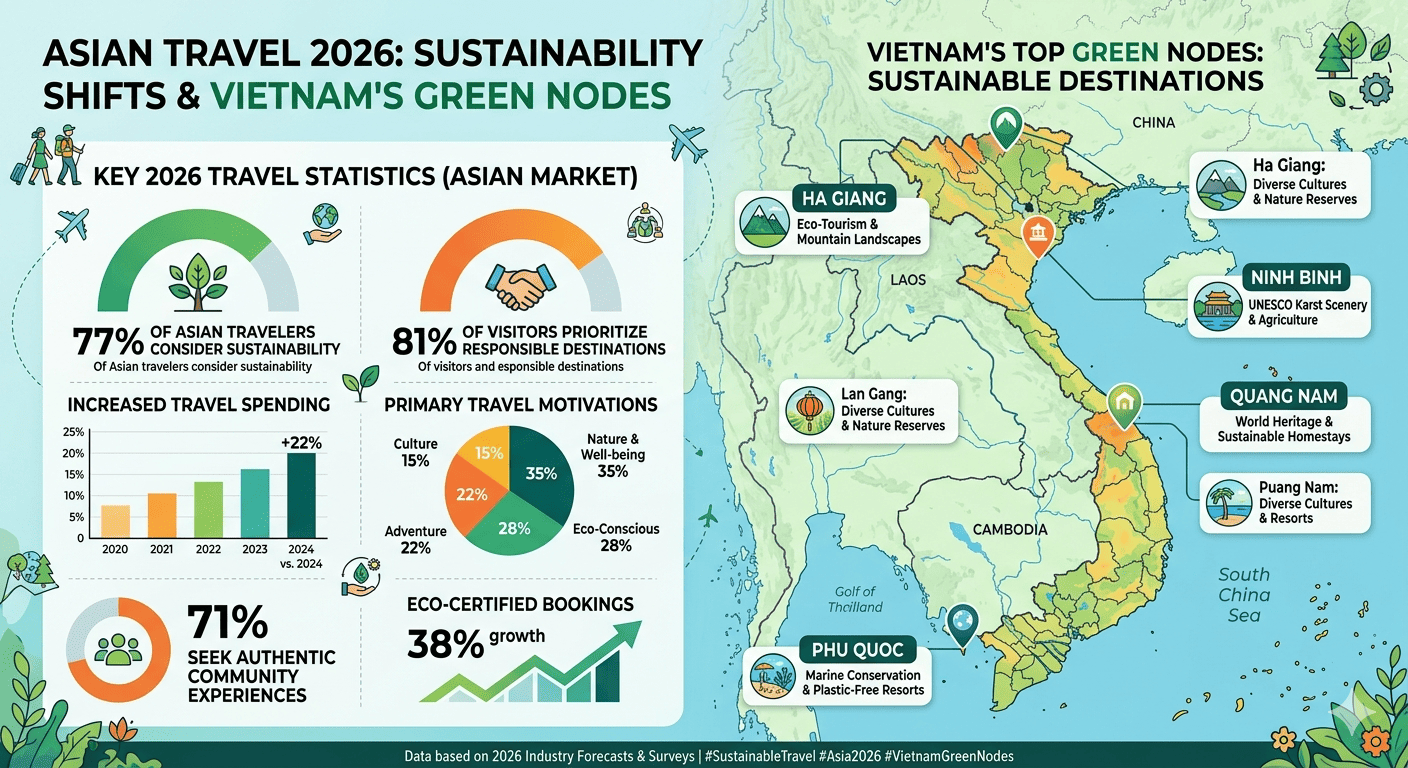
The numbers back up the momentum. According to a comprehensive 2026 consumer survey conducted by digital travel platform Agoda, a staggering 77% of Asian travelers now actively factor sustainability into their trip planning. Within that data pool, Vietnam stands out as a primary driver of the trend: 81% of surveyed travelers identify environmental and social responsibility as a core criterion when selecting a destination, while 43% explicitly seek out accommodation facilities backed by official eco-certifications.
Institutionalized Change: Standardizing the Green Horizon
What separates Vietnam's current eco-tourism boom from temporary "greenwashing" trends is the deep level of structural integration behind it. In alignment with the government's rigorous Net Zero 2050 climate targets, national authorities and trade groups have codified what it means to be a sustainable travel operator.
A major catalyst for this alignment is the implementation of the VITA Green Tourism Criteria, an operational framework introduced by the Vietnam Tourism Association. Designed in strict accordance with the United Nations World Tourism Organization (UNWTO) standards, this matrix evaluates destinations, hotels, and agencies on waste management, single-use plastic reduction, and energy efficiency.
Industry Milestone: As of mid-2026, more than 70 major tourism enterprises and hospitality units nationwide have successfully cleared the auditing process to receive official VITA Green certificates.
Major industry giants are responding in kind. At the landmark Vietnam International Travel Mart (VITM) earlier this year, tier-one operators like Vietravel launched dedicated "New Generation" itineraries completely anchored in ESG (Environmental, Social, and Governance) values. Novel programs such as the "Ben Tre – Net Zero Passport" and "Live Green with the Mekong" are proving that high-volume tourism can actively coexist with resource preservation and carbon-offsetting protocols.
Experience-Centered Travel: Moving Beyond "Sightseeing"
The modern eco-traveler is no longer satisfied with peering at landscapes through the window of a diesel tour bus. The macro-trend is shifting toward what specialists call "Traveling Deeper"—an immersive ethos that prioritizes meaningful cultural exchanges over mass-market consumption.
This experience-centered architecture funnels tourist capital directly into rural and indigenous economies. Rather than placing pressure on local ecosystems, community-based travel platforms turn local traditions into viable, highly valued economic assets that incentivize cultural and environmental preservation.
In regions like Ninh Binh and Quang Nam, visitors actively engage with low-impact wetland and heritage conservation programs, utilizing community-led river transit to explore historic zones. Further north in Ha Giang, travelers participate in eco-conscious trekking and homestays managed entirely by ethnic minorities. Meanwhile, infrastructure upgrades like the Muong Hoa mountain-climbing electric rail transit in Sa Pa demonstrate how modern green transportation can seamlessly integrate into fragile highland systems. Even coastal hotspots like Phu Quoc are adapting, shifting toward regenerative wellness retreats and community-driven coral restoration dives to protect vulnerable marine ecosystems.

The Tech Frontier: Merging Smart Solutions with Nature
Crucially, Vietnam’s green transition is not a step backward into the analog past; it is being supercharged by cutting-edge digital transformation and smart tourism architecture. Major administrative hubs and tourism zones like Da Nang, Hanoi, and Ho Chi Minh City are aggressively deploying AI-driven travel support, contactless e-ticketing networks, and 3D digital city mapping.
By utilizing advanced predictive data models and AI solutions, local operators can map foot traffic patterns to prevent the environmental degradation typically caused by over-tourism. Smart crowd management allows fragile heritage sites to dynamically throttle visitor density, smoothing out peak arrival windows and ensuring that the physical footprint left behind by travelers remains minimal.
As the region charges forward through 2026, the message echoing from Vietnam's bustling travel markets is clear: green transformation is no longer an optional luxury. It is an urgent, competitive mandate that is safeguarding Asia’s most beautiful destinations for generations to come.