
EASA Updates Middle East Flight Advisory: Regulators Maintain Key Airspace Restrictions
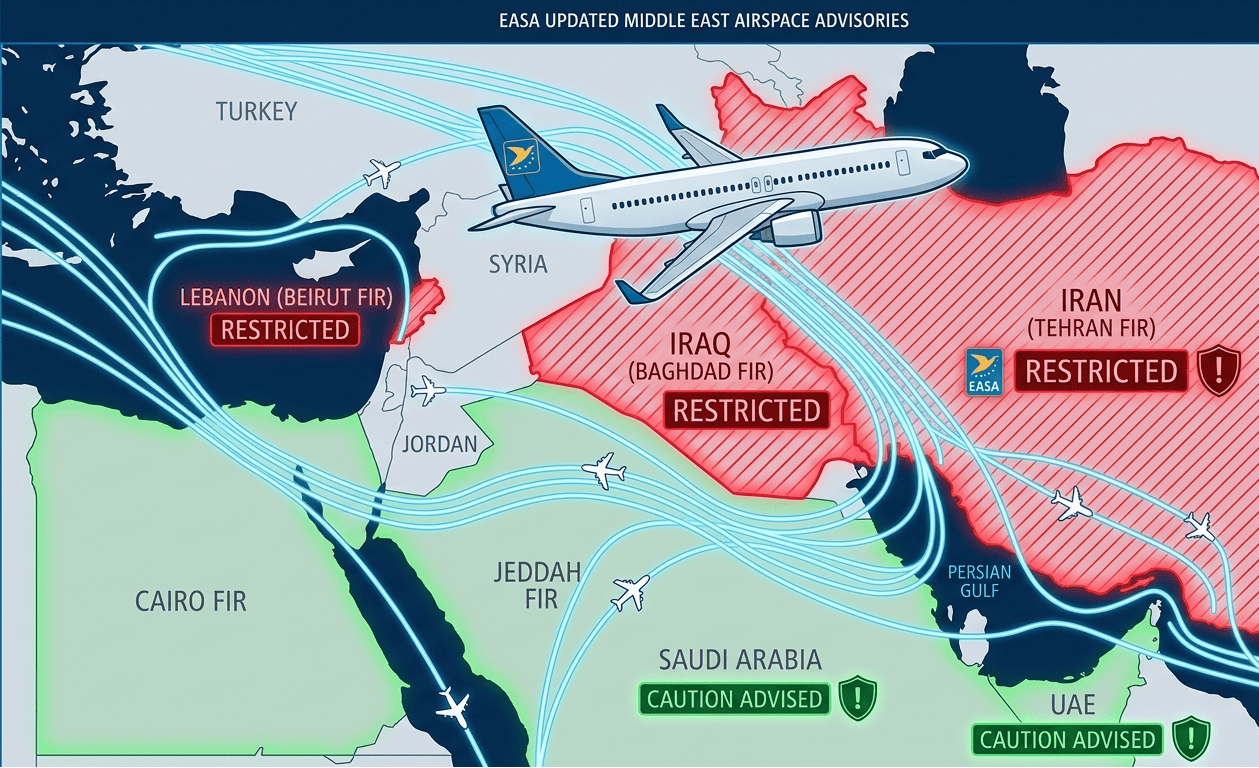
As geopolitical dynamics twist and turn across the Middle East, commercial airlines navigating between Europe and Asia face a continuously shifting jigsaw puzzle of flight paths. In its latest regulatory pivot, the European Union Aviation Safety Agency (EASA) has restructured its airspace warnings for the region.
While recent diplomatic efforts and temporary ceasefires have successfully lowered short-term kinetic threats, European regulators are refusing to let their guard down. Instead, they are trading blanket regional warnings for highly targeted, localized restrictions to mitigate ongoing airspace risks.
For global airlines, flight dispatchers, and risk management teams, understanding the nuance of these updated directives is crucial for ensuring passenger safety without inflicting unnecessary operational costs.
The New Regulatory Framework: High-Risk vs. Residual Risk Zones
Rather than renewing the overarching Conflict Zone Information Bulletin (CZIB) for the entire Middle East and Persian Gulf region, EASA, alongside the European Commission, has transitioned to a split-tier advisory system.
By separating active war zones from areas experiencing residual instability, European authorities provide clear, actionable guidance to carriers under their jurisdiction.
1. Active No-Fly Zones (High Risk)
EASA has issued standalone Conflict Zone Information Bulletins mandating that EU air operators avoid all altitudes and flight levels within the following Flight Information Regions (FIRs):
- Lebanon (Beirut FIR): Despite ongoing trilateral framework agreements, recurrent military activities and insufficient localized risk management have kept Lebanon at a critical threat level.
- Iran (Tehran FIR): Air defense networks throughout Iran remain on high alert following earlier multi-state strikes, creating an elevated threat of accidental misidentification.
- Iraq (Baghdad FIR): Proximity to regional flashpoints keeps Iraq firmly on the restricted list for European carriers.
2. Residual and Medium-Level Risk Zones (Caution Advised)
For the broader Persian Gulf and neighboring territories—including Saudi Arabia, the UAE, Qatar, Oman, Kuwait, Jordan, and Israel—the blanket ban has been replaced by a dedicated Information Note. Airlines are permitted to transit these airspaces but are strongly advised to perform rigorous, flight-by-flight risk assessments.
The Operational Ripple Effect on Global Travel
Maintaining these restricted corridors places a heavy logistical and financial burden on commercial aviation. When major thoroughfares like the Tehran or Baghdad FIRs close, the network effects are felt worldwide.
- Longer Flight Times: Rerouting around closed airspace forces flights connecting Europe with South Asia or Southeast Asia onto elongated paths, frequently tracking heavily south over central Saudi Arabia or far north over Central Asia.
- Surging Fuel Costs: Adding 45 to 90 minutes to an ultra-long-haul flight increases fuel burn by thousands of gallons per trip, driving up overhead costs for airlines.
- Network Congestion: Funneling dozens of diverted international flights into narrow, remaining corridors creates air traffic management bottlenecks, increasing flight delays across the Euro-Mediterranean network.
To monitor real-time traffic impacts and structural re-routing distortions, flight planners heavily rely on data compiled by EUROCONTROL's Network Operations portal to balance efficient flight profiles against regulatory compliance.
Why Regulators Favor Caution Over Optimism
To critics, keeping restrictions in place during active ceasefires might seem overly conservative. However, aviation safety agencies look at structural stability rather than short-term political lulls.
As noted in official EASA Conflict Zone Status Updates, the primary driver behind keeping these restrictions active is the sheer volatility and potential for rapid escalation. Modern air defense systems operate on hair-triggers during geopolitical standoffs; if an early-warning radar misidentifies a commercial airliner due to a technical glitch or a sudden localized skirmish, the results can be catastrophic.
Until local civil aviation authorities demonstrate a proactive, bulletproof methodology for handling deconfliction, European regulators will continue prioritizing safety over routing efficiency.